Showing posts with label murder mystery. Show all posts

Thursday, June 11, 2009

The Masquerade


by Barbara Pavone

As the jagged edges dug into his spine he relished the relief of the cold, wet cobblestones slowly soaking his shirt and soothing his bruises. He had barely any control remaining over his weak body but he exerted himself to force open his eyes. As he did so, he instantaneously regretted the effort. The cloaked figure in the harlequin mask was still staring at him mockingly, as were his equally clad assistants. He had hoped with all his heart and soul that it had been a terrible dream - their continuing presence stated otherwise.

“Wipe that indignity off your face,” snarled the leader of the harlequin army. “Surely you know you brought this upon yourself. Your meddling and so-called ‘constructive criticisms’ alienated our readers and publishers and cost us our careers.”

“No ... one ... ever ... said anything!” pleaded the critic.

At this accusation a universal groan echoed off the walls of the cave and roared in the deteriorating critic’s ear.

“We, kind Sir, always voiced our opinions of disagreement, but you persisted. Your senseless babble made us appear to be nothing more than incompetent, illiterate morons who, in your eyes, could not string two words together. You turned us into the laughing stocks of the literary world!”

On this note the critic felt himself sink farther into an abyss he was now certain he would not return from. He pondered over the masks and the figures seemed to read his mind.

“As a great writer once said: ‘All the world’s a stage.’ You’ve transformed us into fools, mere Harlequins placed into your theatre for comedic relief. We’ve adopted the role for this farewell - our final gift to you, before the curtain falls.”

Trial in the Death of a Critic


by David Docherty

Sequestered in the jury box, the days passed horrifically. How could this have happened? What deviancy leads to such miscarriage of justice? Who could and would devise such a plot? Questions like these torment the mind, scathing the very soul. Adding insult to injury, not being able to unleash the nightmare by talking it over with those owns holds near and dear cages the demons in ones own bowels.

Unsolved mysteries.

A literary critic, found dead at his desk, no discernible cause of demise, yet his brutal suffering obvious upon the silent corpse. Nearby a note, not written but pasted together with foul words cut from his own nasty reviews, no signature attached. Words of hatred spew forth, such as should never be read.

And yonder sits grimacing prosecution attorney, ceaselessly caressing his prized piece of evidence, a voodoo doll found in the writer's guild meeting room, porcupined with pens, pencils and even a feather quill piercing where a heart would lie in a real human being. The doll itself noosed about the neck with typewriter ribbon and hung eerily from the reading lamp which stood beside the very chair the reviewer so arrogantly occupied when he sat in on open mike nights.

Twenty weapons and dozens of fingerprints. More defendants than jurors and yet only one question needs answered. How could this have happened? How could anyone want to prosecute the death of a critic?

by Virginia Winters

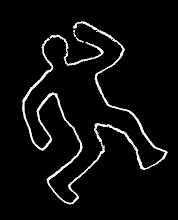
The outline looked like his ego: bloated, empty, one accusing hand outstretched. I stood towards the back of the crowd in the tiny parking lot attached to my bookstore. Henry Adams Cuthbert lay dead. It sounded like the title of a detective novel, the kind he destroyed with his reviews. I turned away and walked back inside.

There were no customers. I didn’t expect any, after the article he wrote about the store. Dark, uninviting, with a would-be author who knows nothing about books behind the counter: the words burned off the page.

He had arrived late and uninvited for the book launch, clutching a bottle of his favourite champagne. He poured a miserly ounce into each glass and raised his. “To my ex-wife: her book is a genuine reflection of her talent. R.I.P.”

That ended the party. The few friends I had left scurried away, murmuring to each other. He tossed his wine glass - rented - into the fireplace and waddled out the back door. He had stolen everything from me that had every mattered. Not my book. I grabbed scissors from the counter and ran after him.

“Henry. Don’t do this to me.”

He turned towards me, looked at the scissors and laughed. “Melodrama. I told you that you couldn’t write.”

I plunged them into his neck, watched the blood ooze around them, saw the unbelieving look in his eyes and watched him die. I wiped my fingerprints off the handles and walked inside to call 911.

Thursday, June 4, 2009

Criticism of a Different Kind


by Patricia Harrington

Chatter swirled in the room, bright and sharp, like the clinking wine glasses. At the reception, readers and novelist wannabees encircled Sinclair Amherst, literary critic. He’d just finished a booksigning and talk about his New York Times best seller, “Foibles and Follies: Life of a Literary Critic.”
Priscilla Owens, owner of the Bookfaire Store on the Sound, had been thrilled when Amherst said he’d do a signing while in the area. The store attracted a large well-to-do tourist crowd. Priscilla had asked her longtime friend, local author Debra Langdon, to assist her with the reception and food. “After all, Amherst did mention your novel in his book.”
Debra’s heart sank at her friend’s request. Yes, Amherst had quoted a passage from her debut novel; but in his chapter on Pedestrian Plotting.
After Amherst’s book came out, Debra’s agent called her. “That killed your chance for a follow-up novel.”
Debra repeated the comment to Priscilla who shrugged it off. “Nonsense. There’s no such thing as bad publicity. You’ll see. It’ll work to your favor.”
As the evening progressed, Debra refilled platters from the seafood and snacks in the kitchen. She prepared a plate for Amherst and handed it to him.
“Enjoy!”
Then she circulated about, covertly observing Amherst who wiped his mouth carefully with a napkin after eating the butterclams.
The clams would taste delicious; too bad they came from a beach with a warning sign—one Debra had chosen to ignore.
Paralytic Shellfish Poisoning. Do Not Harvest.
Pedestrian Plotting
Indeed!

The Tell-Tale Parts

by Ken Duffin

“So here’s the thing,” Ratburner said, his nose twitching. “Julius Pinkle tended to piss writers off. He loathed them. Just read a review.” The publisher of The Canadian Literary Excoriator pushed a pile of quarterlies in the detective’s direction.

Sergeant Thomas declined the offer and repeated his question. “Who wanted him dead?”

“Lunquist.”

“And who’s he when he’s at home?”

“Byron Lunquist. Author of something called Low Hanging Fruit. Silly little twat. But the book was decent enough. Julius disagreed. His review was, shall we say, inflammatory.”

Sergeant Thomas wrote the name in his book and added ‘twat/inflammation’. “Lunquist threatened Pinkle? You know this for a fact?”

“Byron vowed he’d remove Pinkle’s knobbly bits and hang them on his Christmas tree,” Ratburner said. “Near the bottom… so his dog could get them.”

Sergeant Thomas glanced out the window. It was snowing. “Where can I find Lunquist?”

The chalk outline of Julius Pinkle (sans head and minus its block and tackle) was still fresh in the Sergeant’s mind as he pulled up to Lunquist’s house. In the darkness, he could see glow-in-the-dark lips. Then he heard a growl. It was Lunquist’s dog. “Byron Lunquist,” he called out. “I’m arresting you for the murder of Julius Pinkle.” Lunquist, clad only in pajama bottoms and tanning ointment, asked the sergeant what had given it away.

“Pinkle was sporting radioactive dye in his nether bits. He’d had a scan the day before. Your dog’s wearing the evidence,” he said. “Plus,” he noted, pointing to the nicely decorated spruce, “you’ve used Pinkle’s head as a tree topper.”

It was safe to say that the Sergeant could appreciate symbolism and irony as much as the next guy.

Addressing Revenge


by Miriam Clavir

The "R"s in my address book are off-limits, and I hope my friends ensconced there understand I won't be leafing through those pages. In November my chum Greg Richards died, and seeing Richards [crossed-through] still empties my gut. But the "P"s are different, I found out last week. When Sonny Parry was murdered Thursday, that cross-out tangoed. Not just Parry [crossed-through] but Parry [crossed-through] þ .

"Sunny" Parry clouded the Arts page in every goddam article. He reviewed a local poet's launch with, "I hate rhyming poetry, the mark of an amateur, and how this man was allowed past the open mic..." My courtroom crime novel got, "One lawyer I would never hire is author..."

I joined the killer's defense team pro bono. Walking into that first meeting, I could see that the others, all lawyers by the look of their fine grey suits, were there for the same reason. There was a certain gleam in the eyes, a hot tension in the air, a licking of lips.

"He's a cop who writes mysteries. Shot Parry with his service revolver. He's admitted everything." The chief counsel read from his notes. " 'Parry's review stated his police protagonist was unbelievable. That the author should talk to a real policeman.' You can imagine how that went down for our client at the station."

Revenge is a satisfying dish when its victim is cold. We got down to strategy, and the team coalesced. I had the last word, contributing our code name. "To paraphrase Agatha Christie," I said, "The acquittal will come through our Little Grey Cell."

Thursday, May 21, 2009

Speak Softly


by August C. Bourre

The night I killed him wasn’t the first time we’d met. There’d been a reading, not one of mine, and the chubby milk-fed bastard took it upon himself to make introductions. He had wet hands. I don’t expect everyone to be a fan, but when the man who had just demolished my first novel in the Globe presented himself to me as though I ought to be grateful that he stooped to recognize the book at all, I was genuinely offended. He was the most arrogant man I’d ever met. He struck me, and I hope this doesn’t come off as hyperbole, as the sort of man who kicks puppies or lights cats on fire. The son of a bitch needed killing every day of his life. I excused myself as soon as it was polite, and hoped to never hear from him again.

It was two years before I had another book out. My mother had been sick, and I was afraid she wouldn’t live to see a third. Naturally it was dedicated to her. My first novel had sold well, bad review from the Globe aside, so it was only natural those few outlets that still cover books would review my second one. Guess whom the Globe assigned to review it. He found my characters flat, my plot hackneyed, my prose stiff. Every writer will hear these or similar criticisms at one point or another in their career; those I could have lived with. What was unforgivable was his writing that it was good that I dedicated the novel to my mother, as it was the sort of book “only a mother could love.” As though I was unworthy of my mother’s love, had no legitimate claim to her pride in me. As though my gift to her in her final years was a joke.

The second time we met was outside his home near High Park. It was after midnight, and he didn’t see me. I had a silver Smith & Wesson revolver, a little snub-nosed twenty-two. I put the barrel behind his left ear, and let it give a whisper. The bullet rattled around in his skull until his brains were mush. I used a revolver so I wouldn’t have to hunt for shell casings in the dark. The cylinder on the revolver was too large for a Toronto storm drain, so it’s now sitting somewhere at the bottom of Lake Ontario, wrapped in a towel sealed with black hockey tape. I have no doubt it looks like any other rock down there in muck. I didn’t stay to watch him twitch, but I didn’t run either. I got on the first streetcar headed to the lake, and then went straight home. It’s been six months and no policeman has ever knocked on my door. I regret nothing.

Wednesday, May 20, 2009

No Parking


By Gail Farrelly

Her corpse has been wheeled out to the mortuary van, but the chalk outline of the literary critic’s tortured body remains on the blue rug as a creepy reminder for the ten members of my writing club.

She had always ripped apart my mystery stories, saying that they lacked realism. Motive, means, and opportunity, she had reminded me. All three were needed to make a good mystery. Tonight when I decided to do the deed, I remembered that she was allergic to peanuts, and I just happened to have a bag of them in my purse. And oops! A few peanut crumbs had landed in her drink when she left it unattended on the piano for a few minutes.

She would have liked today’s story. Except for the ending.

At many meetings I had quietly seethed at her ruthless criticism. She had taken my dignity, my reputation, and my pride as she had torn apart my work. But today she had stepped over the line and taken something more valuable.

It happened downstairs a few hours ago. Just as I was about to back my Cadillac into a nice big parking space down the block, she sneaked up from the rear in her mini Cooper and maneuvered herself into the space.

I stare at the chalk outline and feel no guilt. This time she had gone too far. As a native New Yorker, she should have known better. Stealing a parking space is punishable by death.

And there’s no appeal.

Open or Closed


by Brian Palmu

MARLOWE:
The unkindest cut (and I’m not talking about the foreskin), he’ll soon be
thrown into a hole in the ground where waning moons press wan light on rabid
curs doing their St. Vitus dance on an unmarked slab. He’s done.

DONNE:
That’s me, Detective.

MARLOWE:
I hope it shall never be so, Constable. Pray, what, again, were his last
words?

DONNE:
This footnote to a particularly vituperative report on the love poems of a
serial bomb builder: “After finishing Mr X’s sixteenth redundant
monstrosity, my spleen may soon explode. Speaking of explosives, in my
garden there’s a strange black bag with a red wire affixed, and snaking
athwart the rustling rhododendron. Think I’ll go investigate ….”

MARLOWE:
As for the murderer, we didn’t need the fingerprinters. Remaindered one week
after the launch, and now the grey pinstripes. Poor shit.

DONNE:
Note the knife’s angle of entry into the critic’s blood-congealed melon. He
was a southpaw, I reckon. Perhaps a Faulkner/O’Connor acolyte? Was the
victim, in sympathy, a federalist, or worse, a formalist?

MARLOWE:
The internecine poetic thrusts and sallies aren't for the faint or feint of
heart, I’m afraid.

DONNE:
What did the wretched scribbler leave behind?

MARLOWE:
No family or friends to speak of. A dented cocker spaniel. A fierce bust of
William Logan. A month’s supply of industrial-strength soap.

DONNE:
Aye. If there were at least one supporter to etch on his cold granite:
“Ultimately, his hands were clean.”

Tuesday, May 19, 2009

Sweet Smell of Death


by Michael Bryson

The chalk remained the next day, faded, smudged. Poorly edited, Cindy couldn’t help remarking to Suzanne, who’d coerced her into attending "the scene of the crime."

"What crime?" Cindy had asked. "He jumped."

Suzanne didn’t agree. No one as confident in his own opinions would need the solace of freshly laid asphalt.

"You think he was pushed?"

Suzanne shrugged. She’d had a crush on the critic, Cindy knew. Suzanne’s slim debut volume of poems was due out the following month, and she’d sent him a copy of the proofs, a pair of soiled undies, and a perfumed card.

"Do you want to get laid or reviewed?" Cindy had asked.

Suzanne replied, "What’s the difference?"

Now they stood over the spot where he’d died. A large death, not a little one. Cindy didn’t understand book people. Especially poets. Why did they hate each other so? Did it all go back to their mothers? Why couldn’t they punctuate or use capital letters?

Cindy imagined the critic on his balcony, wine glass in one hand, Suzanne’s manuscript in the other. The blogosphere had already confirmed the details. Her underwear stuffed under his belt. Her manuscript dispersed across the area. The perfumed card hadn’t turned up.

It wasn’t until days later, when the police came knocking, that Suzanne confessed. Her emails were all over his computer. So, too, was his sharp dismissal of her talent.

"He was allergic, how did you know that?" the solemn police sergeant wanted to know, but Suzanne just smiled.

"Environmental sensitivities," she told Cindy when her friend visited her the following month in custody. "He wouldn’t have been a good critic without them."

The Bookworm Turns


by Larry Lefkowitz

The detective told Kunzman he could erase the chalk outline once filled with the body of Lieberman, the known literary critic.


“Why did you do it?” he asked Kunzman, Lieberman’s assistant, who sat as if stunned by his own act, staring at the chalk parameters of his late mentor.


“It all began the time that Lieberman stole from my brilliant review of a novel by A.B. Yeshua, which I had left on Lieberman’s desk, and which Lieberman, had blatantly seized with his prehensile hands, read, and published with a minimum of changes under his own name, including my most honed metaphors.”


“Thereafter Lieberman continued to ‘borrow’ (his phrase) from my review articles submitted to him and claim them as his own.” Yesterday he did it once too many. I put a stop to the practice.”


“Yes . . . with a bookend to the back of the head.”


Too bad he couldn’t write the obituary for Lieberman, mused kunzman. He would have ended it with the words “In our field of literary criticism there was one Lieberman. It’s doubtful if ever there will be patience for two,” but felt to do so would be to personify the jackass in the fable who kicked the dead lion; accordingly, he settled for the banal (if alliterative) ”Lieberman has left us and literature lackling.” (Sans the need to specify what.) In employing these words, Kunzman could not escape the odd feeling that he was composing an elegy for himself.

How To


by Fred Fawnicoly

So, when kill a book reviewer? Not “critic”, since this north-side-of-the-border hasn’t had a resident critic since Frye died. Reviewers have to have social agendas, since preening’s important to them. Ask around. This is Canada, after all. Everybody knows everybody. Go to a place your hate-object will be, preening. Aim, shoot, and leave.

Who? Book reviewer? Yep, the one getting exposure in the journals, mags and papers that pass your obviously superior work up. ’Nuff said.

Where? In front of as many book maggots as possible. Preferably at a prize-awarding ceremony. Outside on the street, obviously, because only the clique particular to the award will be invited inside. They’re Torontonians. No one will grab you after. Wear a George Bowering mask. Everyone who doesn’t live there hates the West Coast.

How? Well, in a coffee shop near Jane and Finch, I met a guy who knew a guy who’d sell me a 9 millimeter. Met another guy on another day who’d do the job himself, guaranteed, for the same price as the handgun. So your part’s easy enough. Wear a George Bowering mask. Pay the guy who’ll do the job. He won’t give a shit what coast you’re from. He’ll think it’s a Nixon mask.

And what? Yes, a reviewer is a what.
Why kill a reviewer? Well, why kill a cock roach? Why kill a Norwegian rat? Rhetorical questions are sooooo annoying!

Monday, May 18, 2009


by Penn Kemp

Cutting Re: Marks, or The last SOB, or “Only a Play but My Play”, or The Hedge Hog, or The Cock's Comb, or The Head Cheese, or Critical Mass/Mess/Age, or Enough!

Lame!” So the Critic panned my latest play, dismissing months of labour in one derisively decisive cliché. I limp from the computer, crestfallen. Cock o’ the walk, this Reviewer never hedged bets nor minced words so his blog goes viral fast. My thesaurus suggests apt synonyms for Critic: enemy, opponent, detractor, censor, columnist. Calumnist! Drama­- he wants drama? He’ll soon be dead-panning, minced-meat: mark my words. This Detractor will be tracked down. His next review will be his life's, before the screen goes blank.

Revenge is sweet, they say, so I bake a cake when I know he’s coming over. A death-day cheesecake, with tinfoil-wrapped coins for Cerberus inside. Slicing his piece, my knife slips... How clumsy of me, raspberry-icing cake in his face like that. (Beware Playwrights scorned...)

Now I literalize the metaphor, scalping that wigged-out crest right off his head. Underneath is a mass of worms squirming like grey cells: a paper wasp’s nest, a mess of sodden bills in low denominations of payola. A head in hedge funds: that’s how his mind roils. Cutting this long story short, I leave the knife wiggling in his wooden blockhead.

The crummy Critic on my floor looks up beseechingly, mouth rasping scarlet. I lean low under the hedge of wig to catch his last sob: “How could you? It was just a play…” His eyes glaze cherry-red. I’d better be quick before he’s dust. “Eat chalk,” I snarl, stalking off to key in my forthcoming title, Justice: a Play.

Sunday, May 17, 2009

Death By Prose


by Wayne Clifford

It wasn’t that I’d caught him, most of the way through a party at Big Name’s place, with my wife, twice, once in the laundry room, once on the little balcony off the guestroom (it was a breezy summer evening, and in another moment, her black lacies would have flown from her big toe, some regrettable liberation’s flag!). It wasn’t that I’d caught him in the sack with my kid brother after that literary soiree at Three Named Poetess. Not even the incident with my wire-haired pointer, Grisham. No, it was that, after the quick-witted apologies and really clever excuses each time I caught him, his review in the Grub and Moil of my novel in alexandrines, The Cold-Footed Pastor of Gimli, (a passionate tale of Rosie, warm-everythinged and Irish-Cree, and the new-in-town Lutheran preacher, Yan, who was, well, cold-footed (I knew the novel had everything The Great Canadian One could ask for: Winter! Long, long winter! Mounties! Mounties mounting Mounties! Mounties mounting their horses with Tazerish abandon! Baptists! Lutherans! Seal-slaughter!)) was so heavy-handed, it landed like a clot of lead on the composing room floor. Or, more contemporaneously, a splat of weighty polysyllables too flabby to do a push-up between them.

I’d have revenge. I wrote a piece for the anthology he was editing. I knew he’d read it just for the pleasure of rejecting me, and, because it would be brought out by that press using as its mascot the fish-eating flightless bird of a continent no one owns nor wants to, I didn’t even care that the prose started out predictable and pedestrian. No! I mixed every metaphor I could manipulate! I punned pathetically! I advanced the plot academically, I narrated nuancelessly! And I inserted on the penultimate page a priceless paragraph, poetical, paradoxical and so startling with its freshness, that I knew, after the stretch of drivel I’d given him, his aesthetic sense would blow as surely as he’d blown my hound.

So that’s my story, dear reader. Death by prose. And I’ll pull a Mulroney if you ever mention it again.

Saturday, May 16, 2009

No Comment

by Shane Neilson

He looked good, chalked up, chalked off. He deserved it. He had been chalking up books for a few years, getting his start at an Open Mic and confirming his love for his own voice. But getting poetry into journals was a harder task than showing up early at readings, and poetry forced him to modulate his voice, and he wanted to hear his own voice. So he began writing reviews, finding that editors loved blood on the page. And he loved the blood of others on the page. He sometimes went back to the Open Mic, but randomly, to increase the terror, and he refused to read poetry, he read reviews, reviews of the books that were being read that night. The Open Mic organizers let him do it, because they were afraid of him, afraid that he would write reviews about them, and he would, and they knew he would, if they refused him. But his voice: he recorded a whole CD of his reviews, titled it Greatest Hits, and reviewed it himself in a local magazine, the only time –ever, it would turn out- he would uncork the word “masterpiece.” It was an odd voice, a wannabe Caper accent forced through a potato peeler, and it was completely out of sync with its own malice. It is this way I imagine him, stabbed in the back, his assailant refusing to identify himself or even preface his attack with the knowledge that he was about to die, blissfully composing his latest takedown on the way back from the Open Mic where the featured reader that evening, I hear, is smiling as he utters his most famous review, “No Comment.”

Friday, May 15, 2009

Writing Lesson

by Lydia Ondrusek

Ivor Miskelson was a hated child.

Like a weed that sucks up repeated attacks of pesticide to become, finally, poisonous itself, he dealt with the rejection of his relatives and peers, raised himself from the garden plot, and became the grotesque focus of all eyes, unplanned impediment to the growth of everything around him.

Ivor Miskelson became a literary critic.

Read To Me, Miskelson’s television show, was a trainwreck. Millions tuned in every week to see if its host could, by a series of increasingly ugly jabs, again reduce a bestselling author to tears. He did not disappoint. Until Jonquil Esterhaus.

He questioned her lifestyle, laughed at her hat. She admitted her changing from writing children’s books to cozy mysteries could cripple the educational life of a generation. Her demeanor remained serene. After reading the teaparty scene from “I’m Afraid The Vicar Is Out,” she even kissed Miskelson during the closing music. Credits rolled with them deep in conversation, holding hands.

Police responded to a call from Esterhaus the next morning to find her in her bedroom, marking galleys. The late Mr. Miskelson sprawled fully dressed across her calico bedspread, dried spittle on his chin and an empty cup that looked like it had held cocoa clutched in stiff fingers.

“He said I was fascinating, that he wanted to see what I was working on next,” Esterhaus said to the detectives as people dealt with the body. She patted the galley of “The Coroner’s Cocoa.”

“So I showed him.”