Showing posts with label murder. Show all posts

Thursday, June 4, 2009

Criticism of a Different Kind


by Patricia Harrington

Chatter swirled in the room, bright and sharp, like the clinking wine glasses. At the reception, readers and novelist wannabees encircled Sinclair Amherst, literary critic. He’d just finished a booksigning and talk about his New York Times best seller, “Foibles and Follies: Life of a Literary Critic.”
Priscilla Owens, owner of the Bookfaire Store on the Sound, had been thrilled when Amherst said he’d do a signing while in the area. The store attracted a large well-to-do tourist crowd. Priscilla had asked her longtime friend, local author Debra Langdon, to assist her with the reception and food. “After all, Amherst did mention your novel in his book.”
Debra’s heart sank at her friend’s request. Yes, Amherst had quoted a passage from her debut novel; but in his chapter on Pedestrian Plotting.
After Amherst’s book came out, Debra’s agent called her. “That killed your chance for a follow-up novel.”
Debra repeated the comment to Priscilla who shrugged it off. “Nonsense. There’s no such thing as bad publicity. You’ll see. It’ll work to your favor.”
As the evening progressed, Debra refilled platters from the seafood and snacks in the kitchen. She prepared a plate for Amherst and handed it to him.
“Enjoy!”
Then she circulated about, covertly observing Amherst who wiped his mouth carefully with a napkin after eating the butterclams.
The clams would taste delicious; too bad they came from a beach with a warning sign—one Debra had chosen to ignore.
Paralytic Shellfish Poisoning. Do Not Harvest.
Pedestrian Plotting
Indeed!

The Tell-Tale Parts

by Ken Duffin

“So here’s the thing,” Ratburner said, his nose twitching. “Julius Pinkle tended to piss writers off. He loathed them. Just read a review.” The publisher of The Canadian Literary Excoriator pushed a pile of quarterlies in the detective’s direction.

Sergeant Thomas declined the offer and repeated his question. “Who wanted him dead?”

“Lunquist.”

“And who’s he when he’s at home?”

“Byron Lunquist. Author of something called Low Hanging Fruit. Silly little twat. But the book was decent enough. Julius disagreed. His review was, shall we say, inflammatory.”

Sergeant Thomas wrote the name in his book and added ‘twat/inflammation’. “Lunquist threatened Pinkle? You know this for a fact?”

“Byron vowed he’d remove Pinkle’s knobbly bits and hang them on his Christmas tree,” Ratburner said. “Near the bottom… so his dog could get them.”

Sergeant Thomas glanced out the window. It was snowing. “Where can I find Lunquist?”

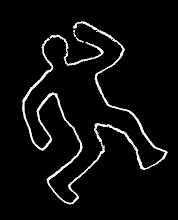
The chalk outline of Julius Pinkle (sans head and minus its block and tackle) was still fresh in the Sergeant’s mind as he pulled up to Lunquist’s house. In the darkness, he could see glow-in-the-dark lips. Then he heard a growl. It was Lunquist’s dog. “Byron Lunquist,” he called out. “I’m arresting you for the murder of Julius Pinkle.” Lunquist, clad only in pajama bottoms and tanning ointment, asked the sergeant what had given it away.

“Pinkle was sporting radioactive dye in his nether bits. He’d had a scan the day before. Your dog’s wearing the evidence,” he said. “Plus,” he noted, pointing to the nicely decorated spruce, “you’ve used Pinkle’s head as a tree topper.”

It was safe to say that the Sergeant could appreciate symbolism and irony as much as the next guy.

Wednesday, May 20, 2009

No Parking


By Gail Farrelly

Her corpse has been wheeled out to the mortuary van, but the chalk outline of the literary critic’s tortured body remains on the blue rug as a creepy reminder for the ten members of my writing club.

She had always ripped apart my mystery stories, saying that they lacked realism. Motive, means, and opportunity, she had reminded me. All three were needed to make a good mystery. Tonight when I decided to do the deed, I remembered that she was allergic to peanuts, and I just happened to have a bag of them in my purse. And oops! A few peanut crumbs had landed in her drink when she left it unattended on the piano for a few minutes.

She would have liked today’s story. Except for the ending.

At many meetings I had quietly seethed at her ruthless criticism. She had taken my dignity, my reputation, and my pride as she had torn apart my work. But today she had stepped over the line and taken something more valuable.

It happened downstairs a few hours ago. Just as I was about to back my Cadillac into a nice big parking space down the block, she sneaked up from the rear in her mini Cooper and maneuvered herself into the space.

I stare at the chalk outline and feel no guilt. This time she had gone too far. As a native New Yorker, she should have known better. Stealing a parking space is punishable by death.

And there’s no appeal.

Open or Closed


by Brian Palmu

MARLOWE:
The unkindest cut (and I’m not talking about the foreskin), he’ll soon be
thrown into a hole in the ground where waning moons press wan light on rabid
curs doing their St. Vitus dance on an unmarked slab. He’s done.

DONNE:
That’s me, Detective.

MARLOWE:
I hope it shall never be so, Constable. Pray, what, again, were his last
words?

DONNE:
This footnote to a particularly vituperative report on the love poems of a
serial bomb builder: “After finishing Mr X’s sixteenth redundant
monstrosity, my spleen may soon explode. Speaking of explosives, in my
garden there’s a strange black bag with a red wire affixed, and snaking
athwart the rustling rhododendron. Think I’ll go investigate ….”

MARLOWE:
As for the murderer, we didn’t need the fingerprinters. Remaindered one week
after the launch, and now the grey pinstripes. Poor shit.

DONNE:
Note the knife’s angle of entry into the critic’s blood-congealed melon. He
was a southpaw, I reckon. Perhaps a Faulkner/O’Connor acolyte? Was the
victim, in sympathy, a federalist, or worse, a formalist?

MARLOWE:
The internecine poetic thrusts and sallies aren't for the faint or feint of
heart, I’m afraid.

DONNE:
What did the wretched scribbler leave behind?

MARLOWE:
No family or friends to speak of. A dented cocker spaniel. A fierce bust of
William Logan. A month’s supply of industrial-strength soap.

DONNE:
Aye. If there were at least one supporter to etch on his cold granite:
“Ultimately, his hands were clean.”

Saturday, May 16, 2009

No Comment

by Shane Neilson

He looked good, chalked up, chalked off. He deserved it. He had been chalking up books for a few years, getting his start at an Open Mic and confirming his love for his own voice. But getting poetry into journals was a harder task than showing up early at readings, and poetry forced him to modulate his voice, and he wanted to hear his own voice. So he began writing reviews, finding that editors loved blood on the page. And he loved the blood of others on the page. He sometimes went back to the Open Mic, but randomly, to increase the terror, and he refused to read poetry, he read reviews, reviews of the books that were being read that night. The Open Mic organizers let him do it, because they were afraid of him, afraid that he would write reviews about them, and he would, and they knew he would, if they refused him. But his voice: he recorded a whole CD of his reviews, titled it Greatest Hits, and reviewed it himself in a local magazine, the only time –ever, it would turn out- he would uncork the word “masterpiece.” It was an odd voice, a wannabe Caper accent forced through a potato peeler, and it was completely out of sync with its own malice. It is this way I imagine him, stabbed in the back, his assailant refusing to identify himself or even preface his attack with the knowledge that he was about to die, blissfully composing his latest takedown on the way back from the Open Mic where the featured reader that evening, I hear, is smiling as he utters his most famous review, “No Comment.”

Friday, May 15, 2009

Writing Lesson

by Lydia Ondrusek

Ivor Miskelson was a hated child.

Like a weed that sucks up repeated attacks of pesticide to become, finally, poisonous itself, he dealt with the rejection of his relatives and peers, raised himself from the garden plot, and became the grotesque focus of all eyes, unplanned impediment to the growth of everything around him.

Ivor Miskelson became a literary critic.

Read To Me, Miskelson’s television show, was a trainwreck. Millions tuned in every week to see if its host could, by a series of increasingly ugly jabs, again reduce a bestselling author to tears. He did not disappoint. Until Jonquil Esterhaus.

He questioned her lifestyle, laughed at her hat. She admitted her changing from writing children’s books to cozy mysteries could cripple the educational life of a generation. Her demeanor remained serene. After reading the teaparty scene from “I’m Afraid The Vicar Is Out,” she even kissed Miskelson during the closing music. Credits rolled with them deep in conversation, holding hands.

Police responded to a call from Esterhaus the next morning to find her in her bedroom, marking galleys. The late Mr. Miskelson sprawled fully dressed across her calico bedspread, dried spittle on his chin and an empty cup that looked like it had held cocoa clutched in stiff fingers.

“He said I was fascinating, that he wanted to see what I was working on next,” Esterhaus said to the detectives as people dealt with the body. She patted the galley of “The Coroner’s Cocoa.”

“So I showed him.”

Thursday, May 14, 2009

The Case of Poe Ethic Justice


by Albert Howard Carter III

Simon Lacerous’ column “The Last Word” routinely excoriated literary works: if realistic, they lacked imagination; if fantastic, they lacked veracity; if existential, they lacked moral compass; if moralistic, they were fascist.

As he left his office one midnight dreary, he was confronted by a hooded figure carrying a stylus, a goose quill, a ballpoint, a laptop, and a scythe.

In a flash, Simon saw the error of his ways and shouted out this devious fiction: “When I woke up one morning from unsettling dreams, I found myself changed into a monstrous vermin. Surely that’s punishment enough?”

The hooded figure opened its cloak, revealing multivariate weaponry. It spoke in sepulchral tones: “If, sir, you were in fact changed into a cricket, I should employ this [it indicated a flyswatter] but I perceive you are a critic, indeed of the most slovenly, ambushing, and puling sort.”

“Perhaps so,” S.L. replied, quickly kneeling, “but I made less money than most writers. Oh, spare me, hooded figure!”

H.F. pursed its lips and extruded a large stick of playground chalk. Its robe swirling, it danced macabrely as it drew—on the alley’s tarmac and around the kneeling critic—the forensic figure of a victim.

“Lie here and don’t go outside the lines,” it ordered.

Simon complied.

H.F. pulled a kalashnikoff from its robe and riddled S.L. with a staccato series of very short bursts, creating umlauts, colons, diereses, ellipses, and, even, periods.

Police, seeing the corpse already with an outline, experienced brain seizures.

A second-story window opened and Annabel Lee, an intern with Marlowe, Poirot & Holmes (also a leggy dame with big headlights and a smart mouth on her) cried out, “Look, yuh lousy flatfeets, it’s obvious you should put out an APB for that punk Chu Aishen!”

THE END

Wednesday, May 6, 2009

Revenge-Lit: The Contest


Everybody Hates a Critic,

Some people hate them more than others.

Terry Griggs’s new comic-noir biblio-mystery Thought You Were Dead kicks, err, off with a literary critic found under a hedge with a knife in his head, and literary revenge plays an increasingly important role as the novel unfolds. The literary world, and especially the Canadian literary world, can be a small, spiteful – and occasionally murderous – place. Character assassinations abound, books are regularly murdered in the (shrinking) book pages across our fair land, while others are smothered with damningly faint praise. More than a few knives, even if thankfully metaphorical, have been buried hilt deep in authorial backs.

Do you bear the scars of CanLit’s internecine wars? Have you spent a small fortune on postage and only have a drawerful of rejection slips to show for it? Has the world been slow to recognize your evident talent? Then, dear reader, this contest is for you.

To celebrate the launch of Terry Griggs’s Thought You Were Dead, Biblioasis and Seen Reading are teaming up to help you unleash the murder we know is in your heart with our Revenge-Lit contest. Pen a flash fiction of 250 words or so (though, in truth, no one is likely to count them) on the (fictional) literary critic whose body once filled the chalk outline and what he did to get there and send it by June 12th to revengelit@gmail.com. The best of the entries will be published as they are received at RevengeLit.blogspot.com. The winning entry will:

1) Receive a one hundred dollar cash prize

2) Be published in a forthcoming issue of CNQ: Canadian Notes & Queries

3) A Biblioasis press catalogue of in-print trade titles (approx. 40 books, retail value approx. $1000.00)

Entries to be judged by Dan Wells, Julie Wilson and Terry Griggs.

No one would suspect the publishing world of murder....

A baseball-capped, bat-eared, tuberous Claymore resident was being interviewed. Chellis turned up the sound to hear him imputing the crime to a) terrorists, b) street gangs from Farclas (ha ha–at least we have streets), c) the baby-killing, pro-choice contingent, and d) his mother-in-law. Using the discordant conjunctions of the sub-literate–like, ya know, get it?–the guy was gumming together these stray strands of conspiracy theory into a single nut cluster. Chellis was placing his bets on the mother-in-law. Witches were once very useful for this sort of thing, but they’d gone out of fashion. No one would suspect the publishing world, barricaded behind their mountainous slush piles, of bumping someone off, but for all anyone knew, their office life could be as vicious as that of academe. Besides, murder required some competence, didn’t it? (Mrs. H frequently vented on the subject of publishing screw-ups.)

-- From Terry Griggs's Thought You Were Dead