Showing posts with label revenge. Show all posts

Wednesday, June 3, 2009

RevengeLit


by Rebecca Rosenblum

The party was dense with scent: mushrooms caps seared with chili oil, J'adore perfume, spilt beer, peach Febreeze.

“You'll like Kenny,” Ravi told Gwen, tugging her across the room “He's a book critic, and you love books!”

A man dressed as a boy turned to greet them. His pretty curls were tied back in a terrycloth scrunchy, his madras shirt untucked from cargo shorts, all pocket flaps open.

He shook her hand firmly.

“So you're a book reviewer—that’s so fascinating!”

“Oh no!” Kenny swigged from a fluted glass of something pink. “Book reviewers write puff pieces for money. A critic...that's not a job, it's a vocation.”

“Still…it must be great to introduce good books to people.”

Seconds passed, Kenny gaping, Gwen squirming, Ravi trying to work a baby carrot through the artichoke dip.

Finally: “Sad to say, that don't happen too often. What kills me is, more often I wind up getting hatemail because I write a negative review of some damn Oprah book about the glory maternal love.”

“But Oprah did Love in the Time of Cholera.”

“You know what I mean, the fucking ‘inspirational reads.’ They fucking kill me.”

Ravi turned for the F-bombs, slopping dip down the buttons of his shirt. “What?”

Kenny slammed down his flute so hard Gwen thought the stem would break. When she reached out to steady it, she discovered it was made out of plastic. “You know what I mean.”

“Actually—” said Gwen.

“When you actually go through publishers’ catalogues, it’s shocking how much garbage gets published every year. The odds an assigned book will result in a positive review are low indeed.”

“There’s lots of new books I like.”

“Seriously? I’m interested, seriously, in getting your perspective. Ravi said you, work in finance, right? So you don’t have the background or anything.”

Gwen thought of all the twisting mysteries, bizarre local histories, glitzy biographies she’d loved in the past year. She could try to deal a serious blow to Kenny’s cynicism. But then she thought about having to continue the conversation another hour, never getting any dip and missing the Balderdash game entirely. And she knew he had to be killed outright.

“Well, one big recommendation is the latest in a series… You might think you know the Chicken Soup books, but I bet you haven’t read the one for the American Idol Soul.”

The plastic glass fell to the floor as Kenny staggered back, gasping, gutshot.

Thursday, May 21, 2009

How to Kill a Critic


by Evie Christie

If this was set somewhere great like Sunset Boulevard, you’d find the critic dead in a pool, here, at the beginning. Anywhere will do though, I’m a poet. A hotel stairwell is sufficient. It’s clear that our critic struggles to become a known, if not renowned, author, that he’d eventually like to be remembered as someone who sold well. That he has been in the vicinity of prominence in writing classes with venerated professors who touched his papers and said kind little words about them, it’s possible. That he mastered the fine art of his own writing and was rewarded with lowly gigs like this one: poetry.

The book aside (it wasn’t great but whose is anymore?) there’s the boorishness, that’s the real issue. What if we were to show up at the same party? I couldn’t stand to see the oh, poor you glances of overworked publicists as they sweat it out in Smart Set ensembles, sneaking half sandwiches all night—not even once. I’m a good girl and as such don’t carry revolvers or pistols or anything helpful. I like blood and guts but I’m also a tidy person, this limits me. I’m also a very serious minded person and I need to get my work done in a timely manner, I have a schedule here above my monitor. Week 1 went like this: 1 line, writing, running, market, housekeeping. Week 2: 2 lines, writing, yoga and so on until I could do more blow than a businessman in a foreign layover suite (with an equally foreign stayover sweet). I cut it less and less into weeks 6-8, by week 14 my habit was forceful and pure. You can get a lot done this way.

I began our meeting with pleasantries, and was, thoughtfully asked back for a drink later. I wondered at how he afforded his hotel drinks and also at how remarkably lousy he would be at fucking. I wore stockings because I always do, they are effective, they set a heightened tone, don’t they? I had a drink and we settled against the coffee table for the evening. It wasn’t everyday ‘ham and cheese lunch’ the dealer had explained, no, it was the kind of blow your mom would pack for your birthday lunch (if mothers even pack their children’s lunches anymore, he scoffed). We did this for most of the night, it’s an aggressive and consuming way to go with an evening and most people end up talking too much and blowing the fine, progressive dread that’s actually become the best part of the experience for me. He was so attached to his childhood dog! You wouldn’t believe it. I suppose we’re all kind of pathetic and human about those things. I could see he would need mouth to mouth or an ambulance--not the dog (that was a straightforward hit and run followed by the kindest of shotgun surprise adieus), the dead guy.

Speak Softly


by August C. Bourre

The night I killed him wasn’t the first time we’d met. There’d been a reading, not one of mine, and the chubby milk-fed bastard took it upon himself to make introductions. He had wet hands. I don’t expect everyone to be a fan, but when the man who had just demolished my first novel in the Globe presented himself to me as though I ought to be grateful that he stooped to recognize the book at all, I was genuinely offended. He was the most arrogant man I’d ever met. He struck me, and I hope this doesn’t come off as hyperbole, as the sort of man who kicks puppies or lights cats on fire. The son of a bitch needed killing every day of his life. I excused myself as soon as it was polite, and hoped to never hear from him again.

It was two years before I had another book out. My mother had been sick, and I was afraid she wouldn’t live to see a third. Naturally it was dedicated to her. My first novel had sold well, bad review from the Globe aside, so it was only natural those few outlets that still cover books would review my second one. Guess whom the Globe assigned to review it. He found my characters flat, my plot hackneyed, my prose stiff. Every writer will hear these or similar criticisms at one point or another in their career; those I could have lived with. What was unforgivable was his writing that it was good that I dedicated the novel to my mother, as it was the sort of book “only a mother could love.” As though I was unworthy of my mother’s love, had no legitimate claim to her pride in me. As though my gift to her in her final years was a joke.

The second time we met was outside his home near High Park. It was after midnight, and he didn’t see me. I had a silver Smith & Wesson revolver, a little snub-nosed twenty-two. I put the barrel behind his left ear, and let it give a whisper. The bullet rattled around in his skull until his brains were mush. I used a revolver so I wouldn’t have to hunt for shell casings in the dark. The cylinder on the revolver was too large for a Toronto storm drain, so it’s now sitting somewhere at the bottom of Lake Ontario, wrapped in a towel sealed with black hockey tape. I have no doubt it looks like any other rock down there in muck. I didn’t stay to watch him twitch, but I didn’t run either. I got on the first streetcar headed to the lake, and then went straight home. It’s been six months and no policeman has ever knocked on my door. I regret nothing.

Wednesday, May 20, 2009

No Parking


By Gail Farrelly

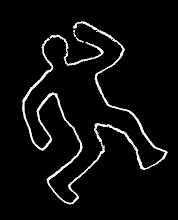
Her corpse has been wheeled out to the mortuary van, but the chalk outline of the literary critic’s tortured body remains on the blue rug as a creepy reminder for the ten members of my writing club.

She had always ripped apart my mystery stories, saying that they lacked realism. Motive, means, and opportunity, she had reminded me. All three were needed to make a good mystery. Tonight when I decided to do the deed, I remembered that she was allergic to peanuts, and I just happened to have a bag of them in my purse. And oops! A few peanut crumbs had landed in her drink when she left it unattended on the piano for a few minutes.

She would have liked today’s story. Except for the ending.

At many meetings I had quietly seethed at her ruthless criticism. She had taken my dignity, my reputation, and my pride as she had torn apart my work. But today she had stepped over the line and taken something more valuable.

It happened downstairs a few hours ago. Just as I was about to back my Cadillac into a nice big parking space down the block, she sneaked up from the rear in her mini Cooper and maneuvered herself into the space.

I stare at the chalk outline and feel no guilt. This time she had gone too far. As a native New Yorker, she should have known better. Stealing a parking space is punishable by death.

And there’s no appeal.

Open or Closed


by Brian Palmu

MARLOWE:
The unkindest cut (and I’m not talking about the foreskin), he’ll soon be
thrown into a hole in the ground where waning moons press wan light on rabid
curs doing their St. Vitus dance on an unmarked slab. He’s done.

DONNE:
That’s me, Detective.

MARLOWE:
I hope it shall never be so, Constable. Pray, what, again, were his last
words?

DONNE:
This footnote to a particularly vituperative report on the love poems of a
serial bomb builder: “After finishing Mr X’s sixteenth redundant
monstrosity, my spleen may soon explode. Speaking of explosives, in my
garden there’s a strange black bag with a red wire affixed, and snaking
athwart the rustling rhododendron. Think I’ll go investigate ….”

MARLOWE:
As for the murderer, we didn’t need the fingerprinters. Remaindered one week
after the launch, and now the grey pinstripes. Poor shit.

DONNE:
Note the knife’s angle of entry into the critic’s blood-congealed melon. He
was a southpaw, I reckon. Perhaps a Faulkner/O’Connor acolyte? Was the
victim, in sympathy, a federalist, or worse, a formalist?

MARLOWE:
The internecine poetic thrusts and sallies aren't for the faint or feint of
heart, I’m afraid.

DONNE:
What did the wretched scribbler leave behind?

MARLOWE:
No family or friends to speak of. A dented cocker spaniel. A fierce bust of
William Logan. A month’s supply of industrial-strength soap.

DONNE:
Aye. If there were at least one supporter to etch on his cold granite:
“Ultimately, his hands were clean.”

Monday, May 18, 2009

Our Needs at This Time

by K. D. Miller
Though your work shows merit, it does not suit our needs at this time.
Okay. Okay. I’m a big kid. I can handle this. God knows, I’ve handled it before. Lots of times. You should see my walls. All of them. Kitchen. Bathroom. (Not the shower, though. Tried it. Papier maché plugging the drain.) But everywhere else. Inside the closets. Right down to the baseboard. When I ran out of wall space, I started putting them in photo albums – the kind with the sticky peel-back plastic. Got whole shelves full of those. Could show them to you, if you came over some time. Would you like that? To come over? You could, you know. Not like you don’t know my address.

Okay. Okay. Consider yourself invited. Or yourselves. You do say our needs. I can just see you all. Sitting around a big table. Maybe in robes with hoods. One of you reads aloud a paragraph, or maybe just a sentence, or maybe just a single word of my work as you call it. Then the leader chants, “Does this meet our needs at this time?” And the rest chant back, “No, it does not meet our needs at this time.” Then one little guy, a castrato they keep just for the purpose, pipes, “Though it shows merit.”
Maybe I’m wrong. Maybe there is just one of you. And you’re using the royal our. Or the divine. Sure. Because that’s who you think you are, isn’t it? God! Fucking God! And that’s why it’s always all about your needs! Because it’s not as if I have any needs of my own! Is it? Of course not!
Sorry. Sorry. It’s just that little cushiony clause: though your work shows merit. It kind of gets to me sometimes. I mean, is it supposed to make my day? Make me feel like at least I’m getting E for effort? Why don’t you just say what you mean, you asshole or assholes – Nice try, sucker, but no cigar.

Sorry. Sorry. I think where this is coming from is that I got your latest today, and I have no place to put it. Even the floors are completely covered. The ceilings. The doors. Windows. Furniture. I suppose I’m just going to have to turn into one of those people you read about sometimes in the paper. You know – the ones who collect stacks and stacks of newspapers or bills, or in my case, rejection slips, and one day the stacks collapse on them and they smother and their cat eats them.
Except I don’t have a cat.
I meant that about coming over some time.
And I’m sorry I called you an asshole.
Or assholes.

The Masticating Critic


The critic couldn’t read if he wasn’t also eating. This was problematic because he had to read a lot. He was on deadline for a review of The Collected Letters of Blake Brinings, Vol II, which collected Briner’s correspondence from age 12 to age 16, about 1,196 pages, not including endnotes and several appendices. It was the largest book he’d seen in some time. He was literally, physically incapable of reading more than a stop-sign if he wasn’t masticating. Beholding the colossal Brinings galley, which felt as heavy as if he was holding his own massive gut in his hands, he’d driven straightaway to the city’s food-supply center, where farmers drove their trucks into an automitive bazaar that the city’s restaurants came to in order to buy their vegetables. The critic had purchased a huge flat of celery from a mute Latino dude in a 49ers cap—about 40 bunches worth. He then drove home, sat down at his kitchen table, and started ploughing through the celery. He’d began dipping it into a low-calorie vinagrette, the recipe for which he’d poached from his stepmother, but he'd eaten so much celery by early afternoon that he was now morosely crunching stalk after stalk, turning the pages in a steady rhythm, occasionally making notes in the margins—little celery and radish-shaped tics of disapproval. The review would be easy to write, because the book was awful. Brinings was a brilliant novelist, but his brilliant novels were published when he was in his 70s, in the early 1980s – an old Australian man inexplicably situated at the white-hot center of London’s New Wave punk-rock scene. A 76-year-old Australian who wrote novel after novel that defined (and redefined) what it meant to be young and New Wave in London in 1981. This is was all well and good, but the letters, this hugely voluminous correspondence from his adolescence in the 1920s, was excruciating stuff. “Mummy loves me, I know it, but she loves me only from a biological imperative. If I met mummy on the street, or in a cocktail bar, mummy wouldn’t give me the time of day. This makes me loathe mummy. I loathe mummy.” This is largely what filled the book’s pages. Um, then suddenly the critic died, because the mute Latino, who was actually a guy who had some fancy literary reason for hating him (wearing a fake mustache, and a fake cap), had poisoned some of the celery. In 'revenge.' Sorry. The end.

Saturday, May 16, 2009

No Comment

by Shane Neilson

He looked good, chalked up, chalked off. He deserved it. He had been chalking up books for a few years, getting his start at an Open Mic and confirming his love for his own voice. But getting poetry into journals was a harder task than showing up early at readings, and poetry forced him to modulate his voice, and he wanted to hear his own voice. So he began writing reviews, finding that editors loved blood on the page. And he loved the blood of others on the page. He sometimes went back to the Open Mic, but randomly, to increase the terror, and he refused to read poetry, he read reviews, reviews of the books that were being read that night. The Open Mic organizers let him do it, because they were afraid of him, afraid that he would write reviews about them, and he would, and they knew he would, if they refused him. But his voice: he recorded a whole CD of his reviews, titled it Greatest Hits, and reviewed it himself in a local magazine, the only time –ever, it would turn out- he would uncork the word “masterpiece.” It was an odd voice, a wannabe Caper accent forced through a potato peeler, and it was completely out of sync with its own malice. It is this way I imagine him, stabbed in the back, his assailant refusing to identify himself or even preface his attack with the knowledge that he was about to die, blissfully composing his latest takedown on the way back from the Open Mic where the featured reader that evening, I hear, is smiling as he utters his most famous review, “No Comment.”

Friday, May 15, 2009

Writing Lesson

by Lydia Ondrusek

Ivor Miskelson was a hated child.

Like a weed that sucks up repeated attacks of pesticide to become, finally, poisonous itself, he dealt with the rejection of his relatives and peers, raised himself from the garden plot, and became the grotesque focus of all eyes, unplanned impediment to the growth of everything around him.

Ivor Miskelson became a literary critic.

Read To Me, Miskelson’s television show, was a trainwreck. Millions tuned in every week to see if its host could, by a series of increasingly ugly jabs, again reduce a bestselling author to tears. He did not disappoint. Until Jonquil Esterhaus.

He questioned her lifestyle, laughed at her hat. She admitted her changing from writing children’s books to cozy mysteries could cripple the educational life of a generation. Her demeanor remained serene. After reading the teaparty scene from “I’m Afraid The Vicar Is Out,” she even kissed Miskelson during the closing music. Credits rolled with them deep in conversation, holding hands.

Police responded to a call from Esterhaus the next morning to find her in her bedroom, marking galleys. The late Mr. Miskelson sprawled fully dressed across her calico bedspread, dried spittle on his chin and an empty cup that looked like it had held cocoa clutched in stiff fingers.

“He said I was fascinating, that he wanted to see what I was working on next,” Esterhaus said to the detectives as people dealt with the body. She patted the galley of “The Coroner’s Cocoa.”

“So I showed him.”

Thursday, May 14, 2009

The Case of Poe Ethic Justice


by Albert Howard Carter III

Simon Lacerous’ column “The Last Word” routinely excoriated literary works: if realistic, they lacked imagination; if fantastic, they lacked veracity; if existential, they lacked moral compass; if moralistic, they were fascist.

As he left his office one midnight dreary, he was confronted by a hooded figure carrying a stylus, a goose quill, a ballpoint, a laptop, and a scythe.

In a flash, Simon saw the error of his ways and shouted out this devious fiction: “When I woke up one morning from unsettling dreams, I found myself changed into a monstrous vermin. Surely that’s punishment enough?”

The hooded figure opened its cloak, revealing multivariate weaponry. It spoke in sepulchral tones: “If, sir, you were in fact changed into a cricket, I should employ this [it indicated a flyswatter] but I perceive you are a critic, indeed of the most slovenly, ambushing, and puling sort.”

“Perhaps so,” S.L. replied, quickly kneeling, “but I made less money than most writers. Oh, spare me, hooded figure!”

H.F. pursed its lips and extruded a large stick of playground chalk. Its robe swirling, it danced macabrely as it drew—on the alley’s tarmac and around the kneeling critic—the forensic figure of a victim.

“Lie here and don’t go outside the lines,” it ordered.

Simon complied.

H.F. pulled a kalashnikoff from its robe and riddled S.L. with a staccato series of very short bursts, creating umlauts, colons, diereses, ellipses, and, even, periods.

Police, seeing the corpse already with an outline, experienced brain seizures.

A second-story window opened and Annabel Lee, an intern with Marlowe, Poirot & Holmes (also a leggy dame with big headlights and a smart mouth on her) cried out, “Look, yuh lousy flatfeets, it’s obvious you should put out an APB for that punk Chu Aishen!”

THE END

Wednesday, May 6, 2009

No one would suspect the publishing world of murder....

A baseball-capped, bat-eared, tuberous Claymore resident was being interviewed. Chellis turned up the sound to hear him imputing the crime to a) terrorists, b) street gangs from Farclas (ha ha–at least we have streets), c) the baby-killing, pro-choice contingent, and d) his mother-in-law. Using the discordant conjunctions of the sub-literate–like, ya know, get it?–the guy was gumming together these stray strands of conspiracy theory into a single nut cluster. Chellis was placing his bets on the mother-in-law. Witches were once very useful for this sort of thing, but they’d gone out of fashion. No one would suspect the publishing world, barricaded behind their mountainous slush piles, of bumping someone off, but for all anyone knew, their office life could be as vicious as that of academe. Besides, murder required some competence, didn’t it? (Mrs. H frequently vented on the subject of publishing screw-ups.)

-- From Terry Griggs's Thought You Were Dead